

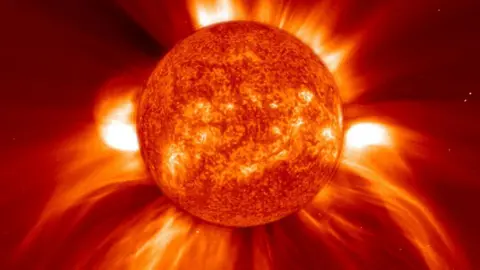
Regarding India's first solar observatory, 2026 will be truly unique.
It's the first time the observatory – that entered in orbit recently – can watch our star during its maximum activity cycle.
As per scientific data, it comes roughly every 11 years when the Sun's polarity reverses – a similar Earth scenario could be the North and South poles changing places.
It's a time marked by intense activity. It sees the Sun changing from calm to stormy and features a significant rise in the frequency of solar eruptions and coronal mass ejections (CMEs) – enormous clouds of plasma that erupt from the solar corona.
Made up of ionized particles, a CME may have a mass of billions of tons and reach velocities exceeding 2,000 miles each second. It can travel toward various directions, even toward our planet. At maximum velocity, the journey takes a CME 15 hours to cover the 150 million km between Earth and the Sun.
"During typical or quiet periods, our star launches two to three CMEs daily," explains an astrophysics expert. "In 2026, it's anticipated there will be 10 or more daily."
Researching CMEs ranks among the most important research goals of India's first solar observatory. Firstly, because the ejections offer a chance to learn about the Sun at the centre of our solar system, and secondly, because activities occurring on the solar surface endanger infrastructure on Earth and in space.

Effects on Our Planet and Space Infrastructure
CMEs seldom present a direct threat to people, yet they impact our planet through generating geomagnetic storms affecting conditions in near space, where nearly 11,000 satellites, including many from India, orbit.
"The most beautiful manifestations from solar eruptions include northern lights, which are direct evidence that charged particles from Sun journey toward our planet," the expert explains.
"But they can also make all the electronics on a satellite malfunction, disable power grids and affect meteorological and telecom spacecraft."
Past Solar Events
- The most powerful solar event ever recorded occurred during the 1859 solar superstorm that disabled communication systems worldwide
- During 1989, sections of Quebec's power grid was knocked out, leaving six million people without power for nine hours
- In November 2015, solar activity disrupted flight operations, leading to chaos in Sweden and various European air hubs
- Recently in 2022, a CME caused dozens of spacecraft failing
With capability to see what happens in the solar atmosphere and detect solar activity or a coronal mass ejection as it happens, record its temperature at origin and track its path, this serves as advanced warning to shut down power grids and spacecraft and move them out of harm's way.
Aditya-L1's Unique Advantage
There are other solar missions observing our star, Aditya-L1 has an advantage over others regarding watching the corona.
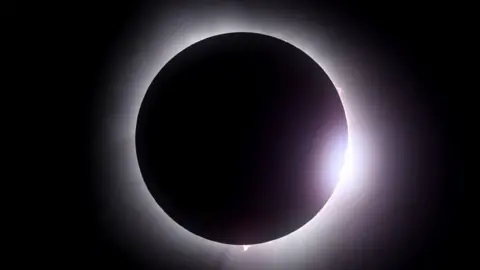
"The instrument has perfect dimensions enabling it to nearly mimic lunar coverage, completely blocking the Sun's photosphere and allowing it an uninterrupted view of nearly the entire solar atmosphere around the clock, 365 days a year, including during eclipses and occultations," notes the researcher.
In other words, this instrument acts like a synthetic eclipse, obscuring the solar glare allowing scientists continuously observe the dim solar atmosphere – a feat the real Moon does only during eclipses.
Additionally, it's unique that can study eruptions in visible light, enabling it to determine eruption heat and heat energy – key clues that show how strong a CME would be if it headed our direction.
Readiness for Maximum Activity
To prepare for the upcoming peak solar activity period, researchers collaborated analyzing information obtained from a major CMEs recorded by the mission has observed recently.
This event began in September 2024 at 00:30 GMT. The eruption's weight was 270 million tonnes – the iceberg that sank Titanic was 1.5 million tonnes.
At origin, its temperature was 1.8 million degrees Celsius with energy equivalent comparable to millions of tons of explosives – in comparison nuclear weapons used in Japan were much smaller and 21 kilotons respectively.
Although the numbers make it sound massive, the scientist describes it as a "medium-sized" one.
The asteroid which wiped out the dinosaurs on our planet carried enormous energy and when the Sun's maximum activity cycle, there may be eruptions with energy content matching greater levels.
"I consider this eruption we evaluated to have occurred during periods of typical solar activity. Now this sets the benchmark for future comparison assessing what to expect during solar maximum arrives," he says.
"The learnings from this will help us developing the countermeasures to be adopted to protect spacecraft in orbit. Additionally, they'll aid us gain deeper knowledge of our space environment," he concludes.


